Download our Free App, Leopp!

Leopp for Google Chrome

Saturday, July 10, 2010

Increase your English Vocabulary on Facebook

As we mentioned earlier, you can learn English with simple things like setting your Facebook account to English. If you are not convinced, let’s take a look at the home page:

Facebook Home

Now, let's review a picture I took back in 2008:

Facebook Picture

Can you tell us the meaning of these words and sentences?
  • News Feed
  • Friends Online
  • What's on your mind?
  • Share
  • Ad
  • Like
  • Tag this Photo
  • Make Profile Picture
Answers

News Feed: This is the place where your friend’s activity appears.
I saw some pictures of your last trip on my news feed. They are wonderful.

Friends Online: Current available friends (to chat with).
Where are you? You don't appear on my Friend Online list, but your sister does.

What's on your mind?: This is a question Facebook asks to encourage you to put what are you thinking or doing.
A penny for your thoughts...I mean, what's on your mind?

Share: When you want to give something to someone, without expecting anything in return, you are sharing. In this case you can share a picture of yourself, a page link or a video you are watching on YouTube.
I like to share on Facebook interesting news that I've read on my favourites online newspapers.

Ad: Advertisement.
Some ads on TV are really creative, but others are silly.

Like: If you like a picture, video or comment, you can click on Like, and let people know about it.
I took this picture by mistake, but oddly people liked it.

Tag this Photo: to id someone by putting a tag or label on a photo.
I tagged my mates on our pictures from the party last night. Some of them look really hilarious; it was fun tagging them with their names.

Make Profile Picture: If you like a picture of yourself, and want to make it your profile photo, click on that link.
I really love Jennifer's profile picture. She looks beautiful when she smiles.

Guest post from Luis M. Gallardo, you can visit his blog about Linux, Programming, Videogames and many other topics. Luis also has a section dedicated to English.
read-more

Tuesday, July 6, 2010

VocaTube - Vocabulary about food on YouTube

VocaTube

We’re starting a new section on the blog to Learn English Online. The idea is simple: to use the thousands of available videos on YouTube to improve our English vocabulary.

The main topic of the videos of this post is food and related content of the kitchen and the adjectives to use when describing food.

Remember that vocabulary can only be improved with practice, and listening through repetition. It’s difficult for everyone to understand from the beginning but you’ll notice that the more hours you listen to English, the better your understanding.

Vocabulary about countable and uncountable words – elementary English


Link to the video on YouTube

Vocabulary about food – elementary English


Link to the video on YouTube

Vocabulary about vegetables, it includes a final exercise – elementary English


Link to the video on YouTube

Video with questions to practice the new vocabulary about food – elementary English


Link to the video on YouTube

Vocabulary for children with subtitled video – elementary English


Link to the video on YouTube

Vocabulary for children in a funny song – elementary English


Link to the video on YouTube

Vocabulary to describe food – intermediate English


Link to the video on YouTube

Vocabulary about vegetables – intermediate English


Link to the video on YouTube

Vocabulary about the kitchen - intermediate English


Link to the video on YouTube

Vocabulary about fruit and nuts – advanced English


Link to the video on YouTube
read-more

Wednesday, June 30, 2010

English for Beginners - Football Vocabulary

Football Vocabulary

Given the craziness about the World Cup that we’re experiencing this summer, we’ve prepared a post for you so that you can watch a football match with the commentary in English, which we’re sure you’ll understand. Moreover, with this vocabulary you’ll be able to make some points and comments about the game and thus show your knowledge of English.

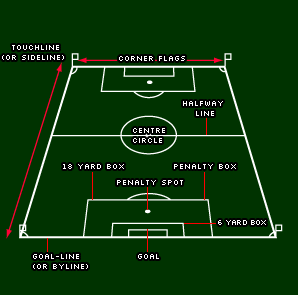
Let’s begin with the stadium and the most important parts of the pitch:

Stadium
Football field / pitch
Goal
Box
Sideline
Halfway line

Pitch Vocabulary

Vocabulary related to teams and players is:

Team
Manager
Player
Goalkeeper
Defender
Midfielder
Striker

Regarding the referees and refereeing activities:

Referee
To referee
Lineman
To book
Yellow card
Red card
Give the foul
Give the penalty
Offside

More vocabulary related to key actions during the game:

Half time
Full time
Extra time
Injury time
The Score
Goal
To win
To draw
To defeat
To shoot
A foul
A free-kick
A corner
A pass
A tackle

Some examples for the use of this vocabulary and phrases commonly used are:

Messi is a fantastic player, he plays for Argentina.

That was a good ball, he almost scored a goal.

The ball is in the box and it’s a clear chance for Brazil.

Oh! What a tackle, he deserved a red card!

This is an amazing team; they keep possession of the ball over 70 percent of the time.

Ronaldo missed the penalty that could have made his team to win.

That player is booked; he already has a yellow card.

Look at that shot at goal; it should have been a goal.

Great defending!

The goalkeeper made a very good save.

A YouTube video where football vocabulary is explained as well is:


Link to the Video in YouTube

To finish, some related links for you to practice football vocabulary in English:

Vocabulary at the BBC

More slang vocabulary at the BBC


Football, History, Vocabulary and Games


Football Dictionary

Podcasts about football in English

Printable files (PDF format) to work on in the classroom featuring this vocabulary about football and also related to the World Cup in South Africa
read-more

Wednesday, June 16, 2010

ManyThings - Interesting Things for ESL Students

Many Things

ManyThings is a website totally recommended for those people who are learning English and want to use the Internet in order to learn English online for free. In ManyThings you’ll find resources to practice every aspect of the English language: vocabulary, speaking, grammar, reading, listening, writing and even singing.

The only feature that could be criticised from ManyThings is its visual aspect. It’s like as if the design of the website hasn’t been updated since the 90’s. However, information is well organised and usability is not bad. Moreover, the resources, materials and activities that you’ll find in ManyThings are really valuable and this is what matters in order to improve your English.

Another interesting feature from ManyThings is that it includes games and activities with lists of vocabulary, grammar exercises, slang, anagrams (an anagram is a word made by using letters of another word in a different order), daily pronunciation practice and also exercises to learn songs in English.

In short, ManyThings is a website that you should visit this summer to practice your English.

Visit ManyThings
read-more

Sunday, June 6, 2010

10 minutes English - Podcasts

10 minutes English - Podcasts

Do you have enough time during the day to make the things that you like? Would you like to learn English but don’t know where to get the time? Your problem is very typical; lack of time is experienced by many. You know, time is money, but in my opinion it’s more valuable than money, since how and where do we buy time? Leaving apart philosophical questions, in this post we describe some handy tips to make the most of your time and improve your English level by listening to podcasts.

To be honest, the idea of this post came to me the other day while reading an article about “10 Minutes Gym” and I thought that there could be many people that would like to learn English but who have very little time during the day. The idea is simple: try to learn English while you carry out other tasks. Two things at the same time, is that possible? Yes it is, and with podcasts it works out very easily.

A podcast is nothing more than an audio file (normally in mp3 format) that you can download from the Internet and copy to your mobile phone (if it reproduces mp3) or an mp3 player like the iPod or any other from brands like Creative, Sony or SanDisk. Once you’ve copied the podcasts you’re interested in, next thing to do is to start listening and enjoying them.

The value of this is that you can do many other activities while listening to the podcasts. Some examples are:
  • While commuting: if you walk, travel by car or any other transport.
  • While doing exercise: we tend to prefer music, but while we run or are at the gym, it’s also possible to listen to podcasts about topics we’re passionate about.
  • While doing the housework: cooking, ironing or general cleaning.
  • When connected to the Internet: while browsing, on Facebook, checking your emails and so on, it’s also possible to listen to podcasts or even some digital radio like for example the BBC one.
  • Even while studying or working: only if you’re allowed to! :)
Why do podcasts help you to improve your level of English? Well, there are several reasons but mainly they can improve “your ear” and your comprehensive skill or listening. You can only improve your ear by practicing and listening once, listening twice and listening once more. Try to download podcasts in different accents: American English, British English, and Irish English... so that you ear gets used to these. Moreover, there are podcasts that contain grammar or vocabulary lessons so you’ll be able to improve your listening, along with other aspects of your English.

Where can I get podcasts? We could list hundreds of websites, but it’s better if you visit our podcast category and decide for yourself. Furthermore, if you have iPod and iTunes then you can subscribe to the podcasts and get updates automatically, it’s very handy.

Would you like to share another activity that you do while you listen to podcasts? Please let us know in a comment.

FYI, the preparation for this post took more than 10 minutes.
read-more
 

| MMXX - learnenglishfromhome.blogspot.com

| This blog is under license Creative Commons

| You can see our Privacy Policy

contact