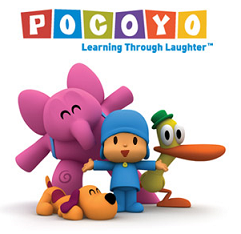
If you like watching cartoons you might probably know about Pocoyo and have laughed with some of his entertaining videos. We’d like to present to you today a list of Pocoyo episodes in English with which you’ll keep the children entertained while they learn and get use to the sounds of the English language.
If one of your resolutions for the New Year is to learn English, we’d like to present you an online resource that will certainly help you to achieve your target. Australia Network is Australia's international television service, beaming 24/7 to more than 46 countries across Asia, the Pacific and Indian subcontinent. The reason why it’s interesting to us is because it offers many great tools to learn English.
On its section to learn English (Learning English), you’ll find learning programs, video podcasts, social networks and communities.
Moreover, on its learning programs, at the bottom of the page there is a very helpful table that explains the recommended programs depending on your level of English: better than beginner, intermediate and advanced. For instance, if you have an advanced level, you should use the programs Nexus, English Bites and Study English.
On the video podcasts section you’ll be able to subscribe to their video podcast feeds and get the latest available Australia Network Learning English programs automatically downloaded to your computer or portable media device. Finally, on the communities section you’ll be able to access to more content from Australia Networks on sites like YouTube, Twitter, Facebook or Orkut.
It’s important that children start learning English from an early age as it’s easier for them to assimilate all the new vocabulary and structures. To help you achieving this, we’ve written this new post containing episodes 10 to 15 of the Pocoyo series.
EmbedPlus is leveraging its enhanced YouTube player to offer free video-centric learning experiences in different domains. The first is a language-focused tool for pronunciation learning.
From looking around, you’ll quickly see that it breaks the dictionary convention of simply providing short and isolated audio snippets by additionally providing time-stamped videos of real speakers using words in real situations.
The goal is to give learners greater context and less mechanical pronunciations for free. In some cases, like the video in the screenshot below, you’ll even get to observe the facial gestures used to produce pronunciations.
Using the tool is easy. Simply enter a word in its search box and you’re automatically given an audio pronunciation if one exists.The audio can be replayed as many times as you need. Most importantly, if videos have been matched to the word, their tiles are listed horizontally for you to click and watch. The enhanced embedded YouTube controls provided by EmbedPlus help you effectively navigate the playback.
To further improve the number and quality of the available videos, our team recently had the idea of time-stamping videos from interested ESL teachers on YouTube and using them as pronunciation examples. This would lead to an ESL specific track within the videos we serve and offer a two pronged benefit: (1) ESL teachers get more English learners viewing their videos as we grow to serve more of the many daily pronunciation requests, and (2) learners are able to gain more than just pronunciations as they watch content that inherently provides language learning lessons.
We suggest that interested teachers explore a few words on the site and find samples within their own videos. Note that we’d prefer to start with examples for commonly used English words that do not currently have matching videos, like awesome, cache, and tomato. If you are interested, please send an email to our team with the YouTube channel information here: submit@epronounce.com.
This is a guest post written by Tay Omojokun, Tay is the cofounder of EmbedPlus.
There is no doubt that in order to get a good level of English, you need to be patient and repeat things a lot. The first time you watch a video or listen to something you probably don’t understand a great deal, but with second and successive hearings as your ear gets used to English the sounds will become more familiar.
This is the idea behind Nobuna, a great website that allows you to improve your level of English by watching videos and completing listening games.
The way it works is very simple; as you go through the exercises, you’ll be absorbing a lot of information by listening to and analyzing the texts. You’ll also be learning and using new words as you fill in the blanks.
The recommended system at Nobuna to learn English is to watch and listen to the entire video without interruption and try to understand the dialogue. Then you watch and listen to the video a second time and try to fill in the blanks. When you’re done with the exercise (it doesn’t matter if you haven’t filled in all the gaps), click on “Finish” to view your results and check them against the video to identify your mistakes and look up words you didn’t understand in the dictionary.
You can see more information about Nobuna on the following video